
In Europe, there are two standards that meet the requirements of the FEI and the local national equestrian federations: the CE standard EN 13158/2018 and the BETA 2018. There are three levels within each of these standards.
The only level accepted for all equestrian activities, including eventing, is the highest level: Level 3 – also known as Level 3.
Over the years, the above standards have been amended on several occasions.
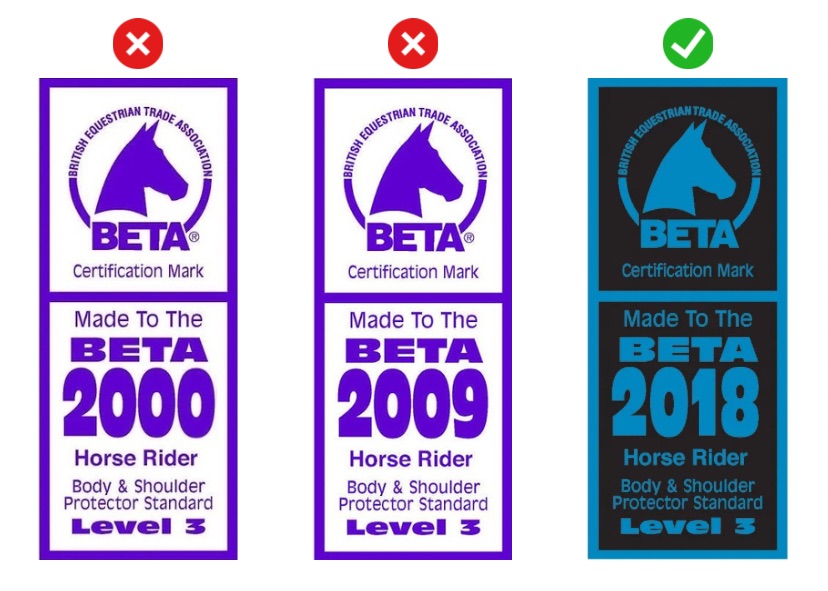
From 2000 until 2009, the EN 13158/2000 – BETA 2000 standard was in force.
- Protectors meeting this standard are therefore at least 17 years old by now!
From 2009 to 2018, the EN 13158/2009 – BETA 2009 standard was then in force.
- Protectors meeting this standard are therefore now at least 8 years old!
The current EN 13158/2018 – BETA 2018 standard has been in force since 2018.
- Everyone should be wearing this now!
Image of BETA labels 2000 – 2009 – 2018
When should you consider replacing your body protector?
1. Have you had your body protector for more than 5 years?
The shock-absorbing materials in your body protector have been carefully selected and combined to absorb the impact of various types of falls.
After 5 years, these materials begin to deteriorate gradually.
How quickly the quality of the foam deteriorates depends on various factors, such as the way it is stored and the number of times it has been dropped.
Furthermore, it is important to note that manufacturers of body protectors are constantly innovating.
Faced with ever-stricter standards, they are constantly on the lookout for better, lighter and more comfortable materials.
2. Does your body protector bear the EN 13158/2018 or BETA 2018 Level 3 label?
The safety standards were revised in 2018. Approved Level 3 body protectors must now bear a turquoise label marked ‘Level 3’.
The previous version of the safety standard dates from 2009. This means that a body protector bearing an EN 13158/2009 or BETA 2009 label is at least 8 years old and at most 17 years old …
If you still have a body protector bearing the EN 13158/2000 or BETA 2000 label, you really must replace it as a matter of urgency; it is at least 17 years old and no more than 26 years old….
3. Does your body protector still fit properly?
It is very important that a body protector fits properly. It must cover certain parts of the body, but it mustn’t be too big either.
We also know that comfort is important. A golden rule is that if a child describes a body protector as uncomfortable, they will often ‘forget’ to wear it.
A few points to check to make sure the body protector fits properly:
- Are all your ribs covered?
- Can you move freely in the saddle, for example, lean back, without your back pressing against the saddle?
- Does the body protector fit like a second skin? (It mustn’t move around on the body)
- You find that the BP is too tight when you’re riding, even when you’ve already adjusted it to the ‘widest’ possible setting using the Velcro and/or elastic fastenings.
Racesafe has body protectors suitable for everyone (petite, plus-size, slim, tall, very tall, …), it doesn’t matter.
The Racesafe HX3 is available in 45 standard sizes. The Racesafe Motion 3 is available in no fewer than 72 standard sizes.
Available from leading equestrian shops.
4. Is there any wear and tear, or are there any significant signs of use?
Body protectors are designed to protect you in the event of a fall or other impact. However, if used frequently. If the body protector shows signs of wear and tear – for example, after frequent falls – you may need to replace it.
The density of the foam (its ability to absorb shocks) decreases the harder the BP is dropped, or when prolonged pressure is applied to the foam.
After a heavy fall, the foam should have returned to its original shape within half an hour. If this is not the case, it is best to replace the BP.
The way you look after the BP when you’re not wearing it is also important for ensuring it lasts a long time.
It is therefore important that you store the BP, ideally at room temperature, in a hanging position.
Extreme temperatures and prolonged exposure to sunlight will affect the quality of the foam. (For example, storing a BP behind the windscreen of a lorry is not a good idea.)
BETA-UK British Equestrian Trade Association UK. (2026, 2 april). Body Protectors - BETA-UK British
Equestrian Trade Association. BETA-UK British Equestrian Trade Association. https://beta-uk.org/body-protectors/